


Content Warning: This article contains discussion of suicide, suicidal thoughts, addiction, and mental health struggles. Reader discretion is advised, particularly for those who may find these themes distressing.
Liam Hughes instantly knew something wasn’t right.
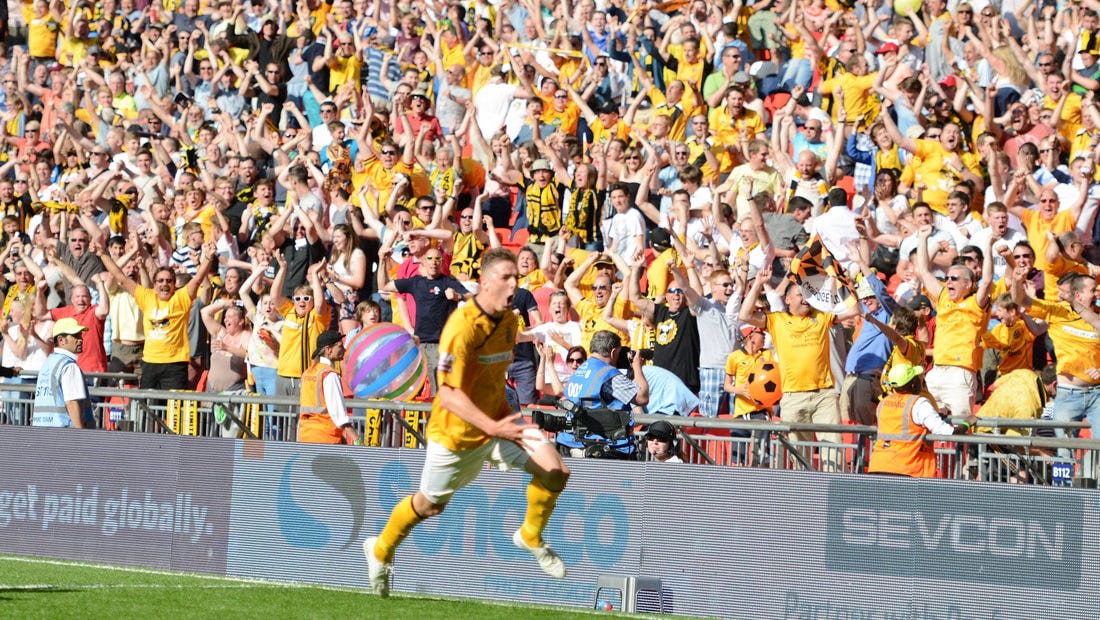
It’s the 23rd of January, 2015. Cambridge United are playing host to one of the biggest football clubs in the world, Manchester United, in the FA Cup Fourth Round. The Abbey feels surreal. The Newmarket Road End resembles a pack of sardines swaying as an uncontrollable mass, pulsating and reverberating with every kick in the type of atmosphere that feels like something from a bygone age.
In the midst of it all, in the 17th minute of the game, Liam Hughes and Phil Jones see the ball bobble up between them.
“I went in for a 50/50 with Phil Jones, and we absolutely clattered each other. And I remember going… something’s not right. I got to half time with adrenaline, and Greg, the physio, said: ‘you’ll be lucky to carry on here. You’ve done your ligaments in your ankle’. It was quite nasty.
“Obviously when we got the replay everyone’s buzzing. I’m buzzing, but I’m on crutches at the same time. I’m thinking to myself ‘I just wanna be fit for the replay’. As a kid all I want to do is play at Wembley and Old Trafford, then I’m sorted.”
It wasn’t to be. United would go on to lose the replay 3-0, and while we all know Hughes’ Wembley exploits, he didn’t get the chance to fulfil the other half of his dream.
What he wasn’t to know was that moment with Jones was to mark not only the beginning of the end of nearly a decade in amber and black, but the start of a much darker chapter in his life. One which would reshape and redefine who he is as a person and test him to his very limits.
“It was after the Man United game when the troubles started. That tackle with Phil Jones was almost like the straw that broke the camel’s back. It was a tough time.
“I just remember saying to people I don’t feel myself. I found myself drinking a bit more, trying to suppress those feelings. That naturally came with a bit of weight and then I was obviously really self-conscious because I was a full-time footballer and I was heavier than I should have been. And then when I left Cambridge, it was all escapism. It was me trying to run away from my own shadow a little bit.
“I was thinking, if I go to Inverness and play in Scotland for a bit I’ll leave all my problems behind. And then from Inverness to Barrow – which is, again, miles away – it’s a new start. A fresh chapter.
“But then when I started in Barrow I progressed from the drink to the drugs – even though it was full-time, it wasn’t like in League Two when you could be drug tested at any point. So then there was the drugs. That escalated from there again. I was going up on a Friday night and drinking before games.”
“It was all a suppression. It wasn’t because I enjoyed it, in fact I hated it, it was to try and escape myself. I wasn’t very kind to myself and I was going through a lot of trouble.
“I even tried to take my own life a couple of times on different occasions with overdoses or drinking, or trying to throw myself in front of a blue light ambulance in York. The height of it was when me and my ex-partner split, and she moved the children away from me down to Southampton, where they still are. And that was when my mental health was at its worst.
“All of that came to a head, and I thought for my own sake and my children’s I’m gunna have to do something. So I ended up going to a Sporting Chance clinic for addiction and recovery and did a month in rehab. And touch wood I’ve come out and been on that path to sobriety ever since.”
When I called Liam to have a chat for this piece, he had just dropped his daughter with his new partner off at football training. There’s a calm and friendly lilt to his voice. It’s hard to square the mythic status a player like Hughes has in my mind with the very human struggles he suffered so devastatingly throughout his career. He tells the story very matter-of-factly. There’s no hiding from it, and no wanting to pretend it was a past life; it’s a part of his story and he’s on a mission to help other people who might be going through something similar.
